As of October 10, 2026
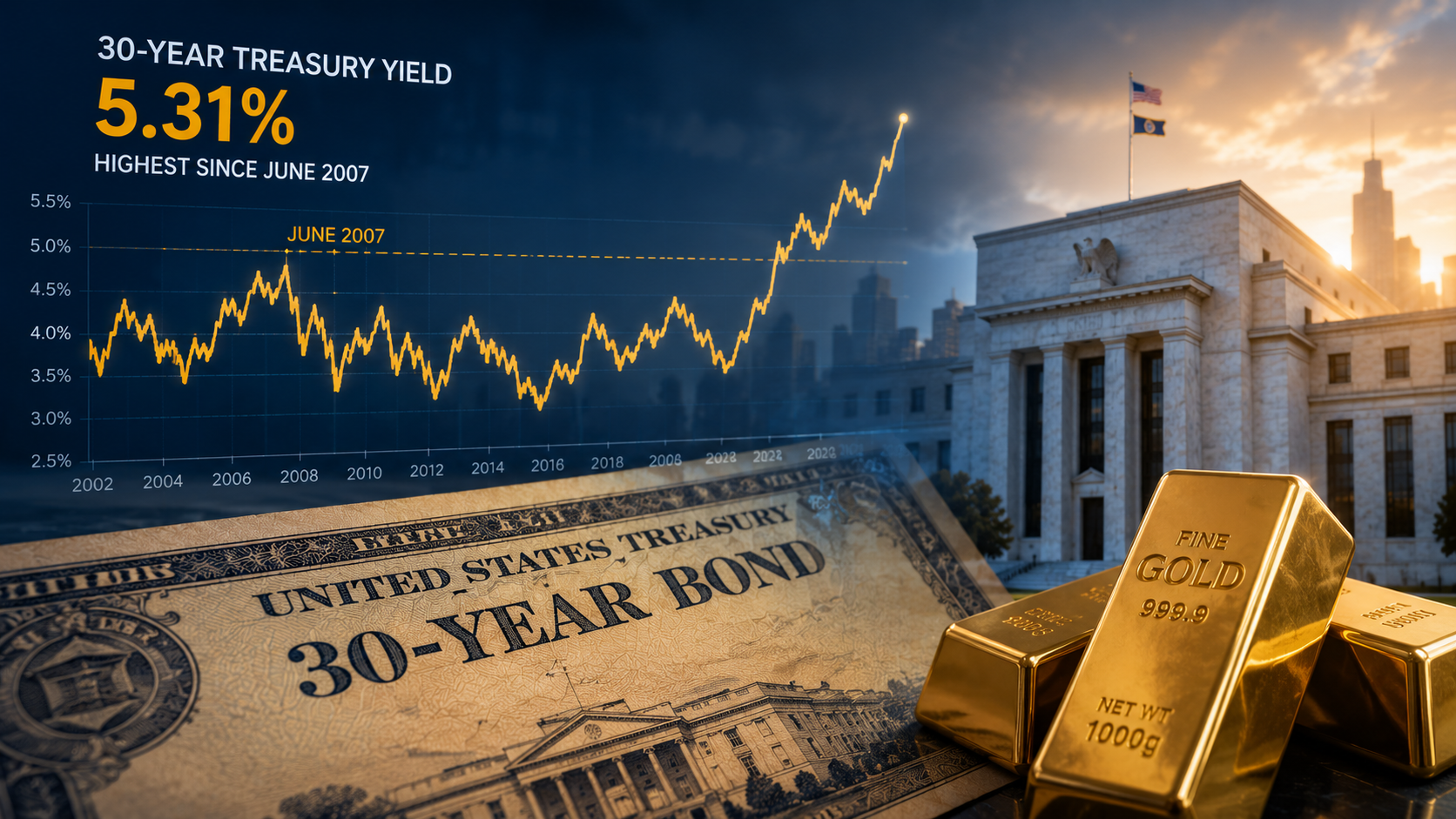
Two developments in today’s markets make an unusual combination for investors approaching or in retirement: stocks are near record highs, and the 10-year Treasury yield is above 5% for the first time in a decade.
For investors still building wealth, the main goal is usually long-term growth. For those drawing income from their portfolios, the challenge is different. The timing of returns can matter almost as much as the returns themselves, particularly when portfolio withdrawals are occurring. This is a sequence of returns risk, and today’s higher yields have changed the economics of managing it.
Losses Cost More than Gains Repay

A 10% decline requires an 11% gain to get back to even. A 25% decline requires 33%, and a 50% decline requires 100%. At a steady 7% a year, recovering from a 50% loss takes about ten years.
Losses are hard to recover from for any investor, but for investors making withdrawals, the problem is compounded. When money leaves a portfolio during a downturn, less capital remains to participate in the eventual recovery. That makes the order of returns especially consequential.
Same Returns, Very Different Retirements

Consider two retirees who each start with $1 million, earn exactly the same twenty annual returns, and withdraw $50,000 at the start of each year. The only difference is when the three losing years occur: at the beginning for one retiree, at the end for the other.
Without withdrawals, both portfolios finish at about $4.6 million. The order of returns makes no difference.
With withdrawals, the results diverge sharply. The retiree who meets the losses early finishes with about $964,000, less than the starting balance. The retiree who meets the same losses late finishes with nearly $2.7 million.
The difference is not how much the portfolios earned; It is when they earned it. Withdrawals taken during a decline are funded by selling assets at lower prices, and those assets are no longer there when markets recover.
What Higher-Quality Defensive Assets Pay Now

One way investors may seek to reduce sequence risk is to hold a source of income and liquidity that does not depend on selling stocks during a downturn. High-quality fixed income or cash can serve that purpose, although each carries risks of its own. For much of the past decade, holding those defensive assets meant giving up most of the income. According to U.S. Treasury market data, the 10-year Treasury yield touched 0.52% in August 2020. $1 million in 10-year Treasuries bought at that yield would have paid about $5,200 a year in interest. Based on a 5.22% yield as of October 8, 2026, interest on the same $1 million would be approximately $52,200 annually.
That figure is close to the $50,000 withdrawal in Exhibit 2, but it is an illustration, not a plan. A bond’s yield is not its realized return. Bond prices fall when yields rise, interest is subject to taxes, inflation reduces its purchasing power, and income changes when bonds mature and the proceeds are reinvested at different rates. Stocks and bonds have also at times declined together in recent years, as we have noted in earlier issues. A reserve is only as useful as its behavior in the years when stocks fall, which argues for diversifying by source of return, not just by asset class. Higher yields may lower the opportunity cost of holding a defensive reserve. They do not remove risk.
What This Means for Investors
Sequence risk is not about predicting when the next market decline will occur. It is about whether a withdrawal plan can withstand one if it arrives at an inconvenient time.
For investors approaching or already in retirement, today’s higher yields are a reason to revisit that balance with a financial professional. Assets often used to seek stability and provide near-term liquidity now offer substantially more income than they did for much of the past decade. That does not eliminate market risk, but it may reduce the cost of preparing for it.
In the end, retirement outcomes depend not only on the returns a portfolio earns, but on when those returns arrive and how much capital remains invested when markets recover.
Disclaimer
Xtollo Investment Partners, LLC (“XIP”) is not a registered investment adviser or broker-dealer. XIP, Portfolio Solutions (“XPS”), a DBA of Kensington Asset Management (“KAM”) and The Leuthold Group (“Leuthold”) are affiliated entities under common ownership. Advisory services are provided KAM (XPS). XIP promotes KAM and Leuthold strategies and funds and receives compensation for these activities, which creates a conflict of interest. Current Form ADV Part 2A (Firm Brochure) for both KAM(XPS) and Leuthold are available upon request and through the SEC’s IAPD at adviserinfo.sec.gov.
Investing involves risk, including possible loss of principal. Past performance does not guarantee future results. No strategy, including diversification, ensures a profit or prevents loss.
Any indices and other financial benchmarks shown are provided for illustrative purposes only, are unmanaged, reflect reinvestment of income and dividends and do not reflect the impact of advisory fees. Investors cannot invest directly in an index. Comparisons to indexes have limitations because indexes have volatility and other material characteristics that may differ from a particular strategy such as the types of securities being substantially different.
This material is for informational purposes only and is not individualized investment advice or an offer to buy or sell any security. Information presented may not reflect current views due to changing market conditions.
Our materials may contain information deemed to be correct and appropriate at a given time but may not reflect our current views or opinions due to changing market conditions. No information provided should be viewed as or used as a substitute for individualized investment advice. An investor should consider the investment objectives, risks, charges, and expenses of the investment and the strategy carefully before investing.
KAM (XPS) relies on third party sources for some of its information that we believe is reliable. However, we make no representation, warranty, endorse or affirm as to its accuracy or completeness. The information provided is current as of the date of publication and may be subject to change. We are not responsible for updating this information to reflect any subsequent developments or events.
Certain information contained herein constitutes “forward-looking statements,” which can be identified using forward-looking terminology such as “may,” “will,” “should,” “expect,” “anticipate,” “project,” “estimate,” “intend,” “continue,” or “believe,” or the negatives thereof or other variations thereon or comparable terminology. Due to various risks and uncertainties, actual events, results, or actual performance may differ materially from those reflected or contemplated in such forward-looking statements. Nothing contained herein may be relied upon as a guarantee, promise, assurance, or a representation as to the future.
Document ID: XT4583315899