As of July 16, 2026
What two months of semiconductor swings are actually telling investors
The Wrong Surprise
For a week, nearly every desk on the Street gave the same guidance: June’s headline inflation would look soft on falling gasoline, so ignore it and watch core, which would prove stubborn near 2.9%. The headline was not the problem. On Tuesday the Bureau of Labor Statistics reported headline CPI fell 0.4% in June, the largest one-month decline since April 2020, taking the annual rate to 3.5% from 4.2%. But core CPI, the number everyone was told to watch, was unchanged on the month and fell to 2.6% year over year against a 2.9% consensus. The Street braced for the wrong surprise, pre-committing to dismiss one number and getting blindsided by the other.

Chart 1. Consensus expected core inflation to hold near 2.9%. It printed 2.6%.
Four Repricings in Six Weeks
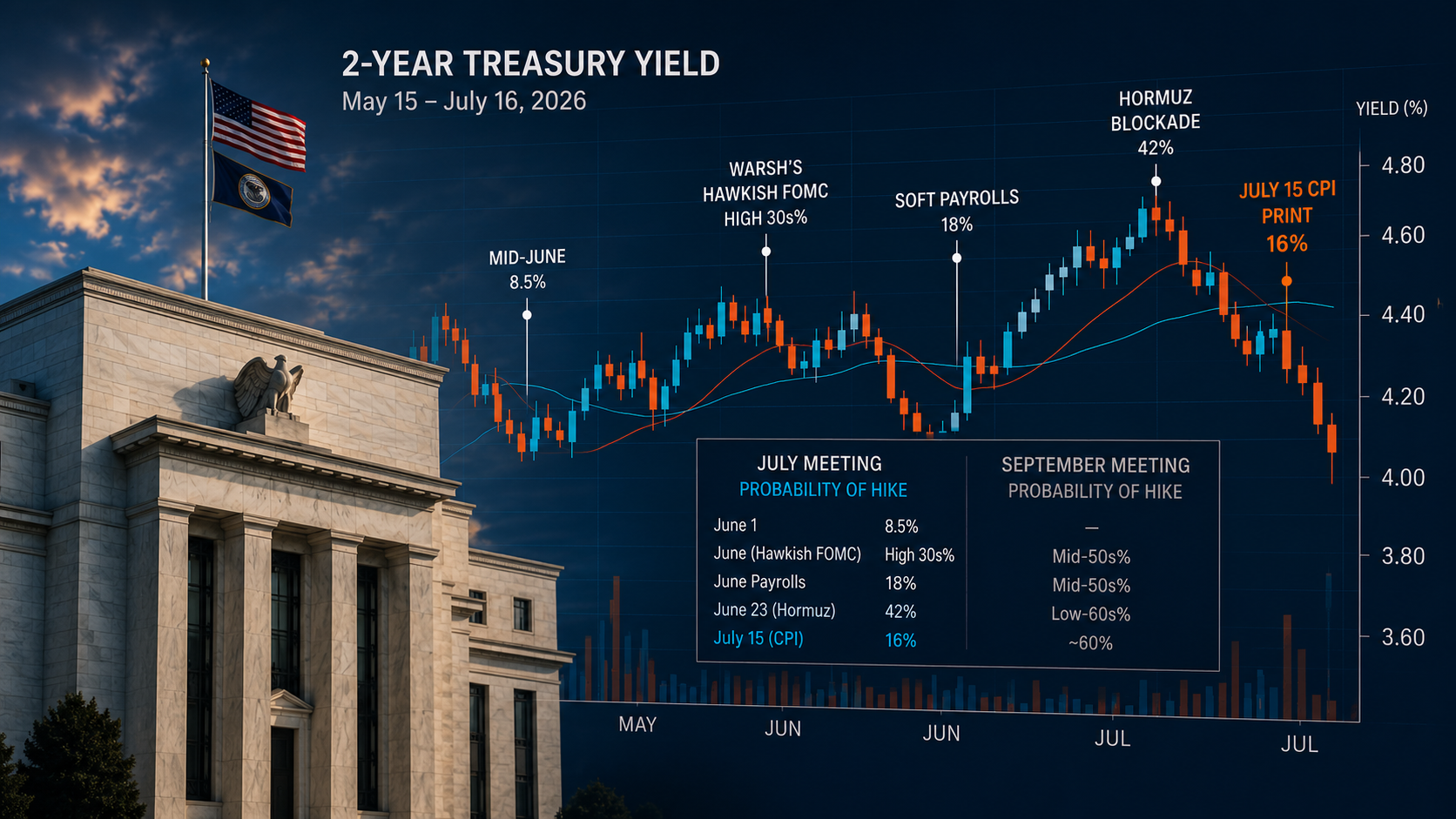
The two-year Treasury yield fell about 8 basis points to 4.18% within minutes of the release, but the policy path told the real story. The implied probability of a July hike, 42% at Monday’s settlement, collapsed to 16% by Tuesday’s close. That is the fourth time the market has repriced this one meeting since June began: 8.5% in mid-June, up to the high 30s on Warsh’s hawkish first FOMC, back to 18% on a soft payrolls print, up to 42% on the Hormuz blockade, and now 16%. Four moves. Six weeks. One meeting.

Chart 2. The July meeting (navy) has been repriced four times since June 1, collapsing from 42% to 16% on the CPI print alone. The September meeting (gray) has held above the mid-fifties since Warsh’s first FOMC.
In our view, the gray line may be the more significant indicator. Since Warsh’s first meeting, the probability of a higher rate by September has never fallen below the mid-fifties, and it still sits near 60% even after Tuesday’s surprise. Read together, the two lines suggest a market focused more on the timing of potential tightening than on whether tightening may occur, and it changes its mind every time a headline crosses the tape.
A Measurement of a Month That No Longer Exists
June’s disinflation was almost entirely an energy story. The CPI energy index fell 5.7% on the month, because a ceasefire had reopened the Strait of Hormuz and pulled Brent from the mid-nineties down to roughly $72 by month end. That ceasefire collapsed on July 8. The administration reinstated a targeted naval blockade of Iranian shipping and briefly floated a 20% levy on all cargo through the strait, dropping the toll within a day under Gulf pressure. Even with the fee abandoned, the blockade and renewed strikes held the risk premium in place: Brent closed Tuesday at $86.61, some 19% above where June finished and more than halfway back up the decline that produced Tuesday’s soft number. The June report measures a world that may have already been overwritten.

Chart 3. The shaded band is the month June CPI measured. Brent has since retraced more than half of the decline that produced it.
The Cost of Not Guiding
On the same morning the market swung twenty-five points of probability on a single data release, Chair Warsh was two miles up Constitution Avenue telling the House Financial Services Committee that the Committee has “no tolerance for persistently elevated inflation.” What he would not tell them was what the Committee intends to do about it. He has declined to submit a projection to the Fed’s dot plot. He spent much of the hearing deflecting questions on the rate path, observing at one point that being overly tied to forward guidance when the situation changes is “not the way we want to do things.”
This is doctrine, not evasion. Of the five task forces Warsh announced in his opening statement, the first is charged with assessing the form and function of Federal Reserve communications, and specifically with asking what the risks are of how the Committee currently deliberates and conveys its policy choices. The chair of the Federal Reserve has opened a formal inquiry into whether the central bank should be telling markets what it plans to do at all.
Reasonable people can disagree about whether forward guidance ever served markets well. Many market participants would argue that it functioned as an anchor. Remove it, and every data release carries the entire informational load by itself. A twenty-five point swing in a meeting probability on one monthly print is what an unanchored front end looks like. This may reflect the practical effect of the current communication approach, and Tuesday illustrated those effects
The Test Arrives Every Morning Now
Wednesday made the point again. June producer prices fell 0.3%, the largest monthly decline in three years, on the same energy reversal that shaped the CPI, yet the core measure rose again and the twelve-month rate held above 5%. A second soft headline in twenty-four hours, sitting on prices that have not actually stopped rising. Warsh had already refused the easy read, telling the House that anyone calling the CPI “mission accomplished” did not speak for him, and repeating the case before the Senate on Wednesday.
For an advisor, the discipline this argues for is a posture, not a market call. The front end may continue to move sharply and often, in both directions, on each release, because the Committee has withdrawn the guidance that used to smooth those moves in advance. An investor who positioned duration against a July call at any point in the last six weeks was whipsawed four times on information unknowable a week earlier. Those four repricings are not an aberration to wait out; they may represent a new market environment, with two more inflation prints and an FOMC meeting before summer ends. In our view, the direction of policy risk may be more informative than short-term timing fluctuations, which remain volatile.
Methodology and Sources
Data cutoff. All market data in this piece, including the probabilities in Chart 2 and the Brent prices in Chart 3, is as of the close on Tuesday, July 14, 2026. Market-implied probabilities move continuously and will have changed by the time of publication.
Inflation figures are from the Bureau of Labor Statistics Consumer Price Index news release for June 2026 (USDL-26-1191, released July 14, 2026). Year-over-year rates in Chart 1 are computed from not-seasonally-adjusted index levels (CPIAUCNS, CPILFENS via FRED), which is the basis BLS uses for its published 12-month figures; month-over-month figures cited in the text are seasonally adjusted, as reported by BLS. Consensus estimates are the Dow Jones economist survey as reported by CNBC on July 14, 2026.
Chart 2 plots the implied probability of a fed funds target above the current 3.50% to 3.75% range, computed as the sum of implied probabilities across all higher target ranges, from CME FedWatch Tool meeting probability history files for the July 29 and September 16, 2026 meetings. Treasury yields are Constant Maturity Treasury par yields published by the U.S. Department of the Treasury. Brent crude is the front-month futures daily close (BZ=F). Chair Warsh’s remarks are from his semiannual Monetary Policy Report testimony before the House Financial Services Committee, July 14, 2026, as published by the Federal Reserve Board, and from press reporting of the question-and-answer session that followed.
Risks and limitations. This piece describes market-implied probabilities, which are derived from futures pricing and reflect the market’s expectations rather than forecasts by Xtollo. Probabilities move continuously and the figures cited are as of the close on the dates stated. A single monthly inflation reading is subject to revision and to sampling error, and neither this piece nor the data it cites should be read as a prediction of the July FOMC outcome or of subsequent inflation prints.
XT20260716