Market Insights: Is the Market Setting Up for Disappointment?
After a year of stellar earnings and record-breaking market performance, 2025 is shaping up to be a different story. While fourth-quarter results for 2024 delivered the highest year-over-year earnings growth since Q4 2021, early indicators suggest that the road ahead may be more challenging. Elevated valuations, tighter credit spreads, and a more punitive market reaction to earnings misses are all signs that investor optimism could be on shaky ground.
Earnings Expectations: From Strength to Skepticism
Through February 14th, fourth-quarter 2024 earnings for the S&P 500 are on track to have grown by 16.9% year-over-year (compared to 11.8% expected)—the strongest growth rate since Q4 2021. Yet, the outlook for Q1 2025 is more tempered: 42 S&P 500 companies have issued negative earnings guidance, compared to 33 with positive guidance.
Market reactions have shifted as well. As shown in the chart below from 3Fourteen Research, investors are punishing earnings misses more severely while rewarding beats with more muted gains. This dynamic potentially signals that the market is becoming less forgiving and more discerning, a departure from the broad enthusiasm that characterized much of 2023 and 2024.
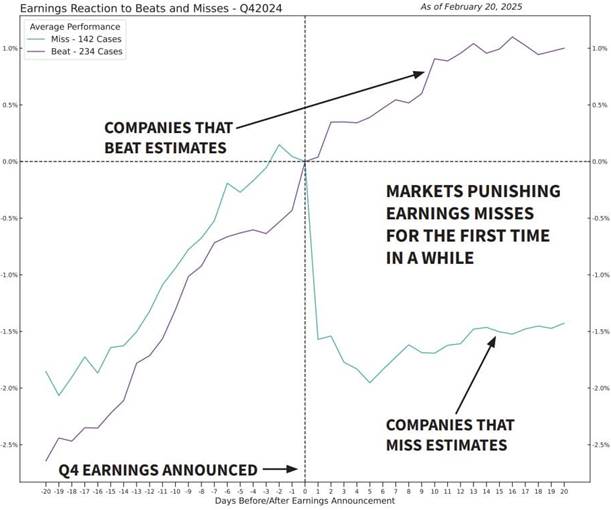
Source: 3Fourteen Research as of February 20, 2025
- Companies that missed estimates (blue line) experienced an immediate drop post-announcement, with little recovery in the days that followed.
- Companies that beat estimates (purple line) still saw gains, but the magnitude was notably smaller compared to prior quarters.
This shift in investor reaction suggests that elevated market valuations leave little room for error—a concerning sign given that the S&P 500’s forward P/E ratio of 22.2 is well above both its 5-year average (19.8) and 10-year average (18.3).

Source: FactSet as of February 14, 2025
Higher Expectations, Limited Margin for Error
Investor optimism remains elevated, but recent economic data suggest that expectations may need to be recalibrated. The Citi Economic Surprise Index has been trending downward since late 2024, indicating that recent data releases have consistently fallen short of forecasts.
Moreover, Q1 GDP growth estimates, as measured by the Atlanta Fed GDPNow Estimate, have already been revised downward by nearly 1% within just a month of data releases—a notable adjustment that reflects a more cautious economic outlook.

Source: Atlanta Federal Reserve and Cbonds as of February 24, 2025
One key concern is that Personal Consumption Expenditures (PCE) remain the primary driver of growth in the GDPNow estimate. With PCE showing signs of moderation, sustaining the current pace of economic expansion may prove increasingly difficult—particularly as fiscal policies from the new administration begin to take effect.
This Friday’s upcoming PCE inflation report (February 28th) will be closely watched, as its results could significantly impact market sentiment. A higher-than-expected reading would likely rattle markets, signaling persistent inflation that could delay anticipated Fed rate cuts and tighten financial conditions. Conversely, a lower-than-expected reading might provide temporary relief, though it could also raise concerns about weakening consumer demand—the last pillar supporting growth.

Source: Atlanta Federal Reserve as of January 30, 2025
Credit Markets: A Signal of Complacency?
While equity markets remain near all-time highs, the bond market is sending a more cautious signal. High Yield spreads have remained below 3% for over 100 consecutive days—a streak last seen in May 2007 (chart below), just months before volatility surged and the financial crisis unfolded.
Historically, prolonged periods of tight credit spreads have often preceded market corrections, as they can reflect investor complacency and an underestimation of potential risks. However, tight spreads can also indicate confidence in the economic outlook during periods of stable growth. Given the recent weakening of economic data, any deterioration in credit conditions could lead to a rapid repricing of risk assets.

Source: St Louis Federal Reserve (FRED) as of February 24, 2025
Final Thoughts: Navigating the Risks Ahead
As we move further into 2025, several key questions remain:
- Will Q1 earnings results validate current valuations, or will they fall short of expectations?
- Can the economy maintain its momentum amid tighter financial conditions and shifting fiscal policies?
- How long can credit markets remain complacent before volatility returns?
While the market has shown remarkable resilience, the early cracks in economic data and investor sentiment suggest that a more cautious approach may be warranted. In the near term, upcoming earnings reports and inflation data will be critical in shaping market expectations. If current trends persist into the second quarter, the combination of high valuations, weaker economic data, and tighter financial conditions could weigh on market performance throughout 2025. However, should economic indicators and earnings improve, the market may still have room to sustain its current levels despite elevated valuations. In a market where expectations are high and the margin for error is slim, investors should prepare for increased volatility as the year progresses.