Market Insights: The Federal Reserve Deserves More Credit
The Federal Reserve has faced no shortage of criticism over the past few years. From accusations of being too slow to raise rates in the face of rising inflation to concerns about overtightening and triggering a recession, the Fed has been a lightning rod for blame. Yet, as the Fed held rates steady at yesterday’s FOMC meeting, it’s worth taking a step back and acknowledging that, despite the challenges, the Fed has done an admirable job. This week, we explore four charts that highlight the Fed’s successes, while also acknowledging the risks that remain.
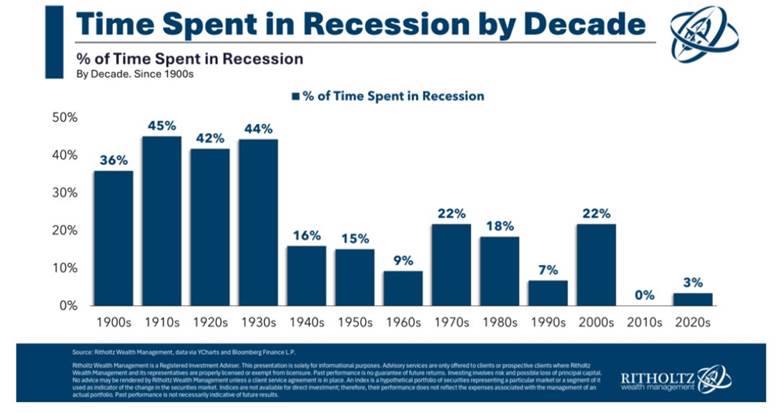
A Remarkable Record – Only 2 Months of Recession in 15 Years
The US economy has been remarkably resilient over the past 15 years, with only 2 months of recession during that time. This is a testament to the Federal Reserve’s ability to navigate a series of unprecedented challenges, including the Global Financial Crisis, the COVID-19 pandemic, and the most aggressive inflation surge in decades. Despite these events, the Fed’s policies have helped sustain economic growth and avoid prolonged downturns. While critics often focus on the Fed’s missteps, this chart underscores the central bank’s overall success in maintaining economic stability.
Inflation Improvement on the Horizon – Friendly Year-over-Year Comparisons
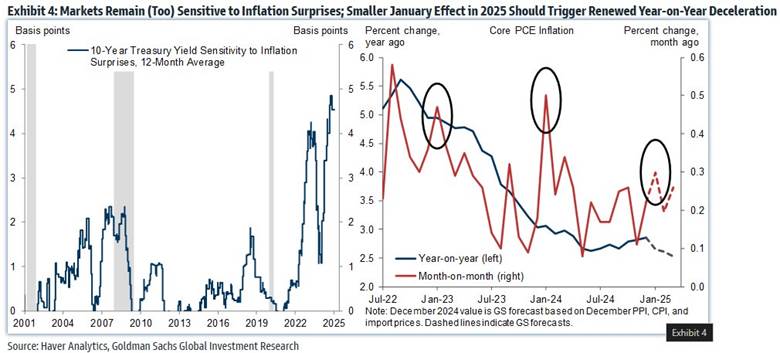
Inflation has been the Fed’s biggest challenge in recent years, but there are signs that the worst may be behind us. The chart shows that CPI and PCE inflation measures are set to benefit from favorable year-over-year comparisons in the coming months, which should help the disinflation trend continue. This is a positive development, suggesting that the Fed’s efforts to tame inflation are paying off. Additionally, the strong start to Q4 earnings season indicates that corporate America is weathering the inflationary environment better than expected, further supporting the case for a soft landing.
Strong Start to Q4 Earnings – A Testament to Economic Resilience
The Q4 2024 earnings season is off to a strong start, with S&P 500 companies reporting robust growth despite ongoing economic uncertainties. As of January 24, 2025, 16% of S&P 500 companies have reported actual results, and the numbers are encouraging. The blended (year-over-year) earnings growth rate for Q4 stands at 12.7%, marking the highest growth rate since Q4 2021. If this holds, it will be the sixth consecutive quarter of year-over-year earnings growth for the index. Additionally, 80% of companies have reported positive EPS surprises (chart below), which is above the 5-year average of 77%.

Source: Factset as of January 24, 2025
Some critics may argue that the strong earnings and elevated valuations are a result of loose monetary policy, particularly the Federal Reserve’s rate cuts since August 2024. While it’s true that accommodative policies have provided a tailwind for corporate earnings, it doesn’t seem to be impacting inflation, as noted above.
This suggests that the Fed’s policies have struck a delicate balance: supporting economic growth and corporate profitability while also bringing inflation under control. The fact that earnings growth remains robust even as inflation cools is a testament to the resilience of the US economy and the corporate sector.
The Wildcard – Uncertainty Around Tariffs and Trade Policy
While the Fed has done a commendable job in managing inflation and supporting economic growth, there are still risks on the horizon. One of the biggest wildcards is the uncertainty around US trade policy, particularly the potential for increased tariffs. While the broader effects of tariffs — including national security considerations, job creation, and the protection of domestic industries — are still being debated, several studies (chart below) suggest that a scenario with higher tariffs could reduce the size of the US economy by approximately 2% over the next decade. This highlights the complexity of trade policy and serves as a reminder that, while the Fed has control over monetary policy, it has little influence over fiscal and trade policies, which could pose significant risks to the economy in the coming years.

Final Thoughts
The Federal Reserve has faced its fair share of criticism in recent years, but the data suggests that the central bank deserves more credit than it often receives. With only 2 months of recession in the past 15 years, the Fed has successfully navigated a series of unprecedented challenges. Inflation is showing signs of improvement, and the economy appears to be on track for a soft landing. However, risks remain, particularly around trade policy and tariffs, which could pose challenges in the years ahead.
For investors, the message is clear: while the Fed has done a commendable job, it’s important to remain vigilant and prepared for potential risks. By acknowledging the Fed’s successes while also keeping an eye on the challenges that lie ahead, investors can better navigate the complexities of the current market environment.